Casualties of War - Putting American Casualties in Perspective
by - November 3, 2003
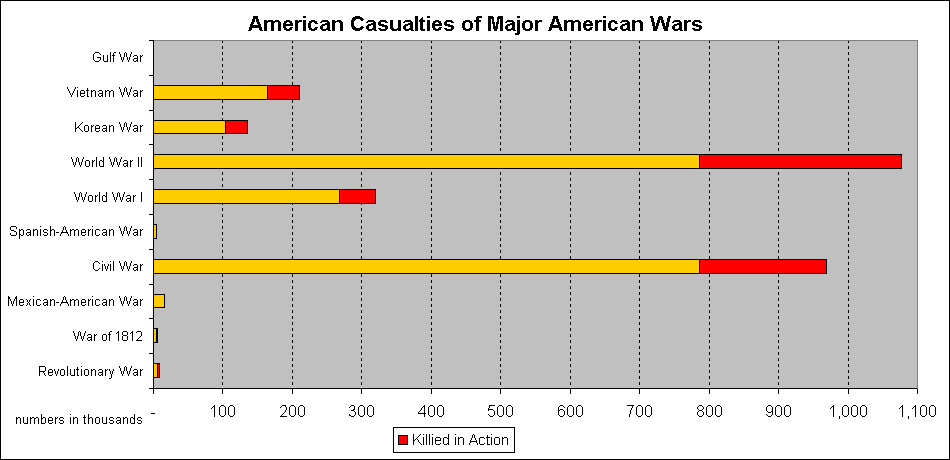
The United States of America has a somewhat unique relationship with war. While America is considered to be the most militarily powerful country in the world today, Americans as a whole have never experienced war in the way that many other countries of the world have. There is a huge disparity between the American experience of war and the global experience. This may have an impact on American attitudes towards war. Presented below are various statistics on causalities of war. The information is useful for reference material, but it is also useful for gaining an understanding of the human cost of war, and the cost of war for Americans compared to the rest of the world, which may be helpful in understanding cultural attitudes about war.
The total number of Americans killed in action from all major wars combined, the ten listed below, is 2,757,196, which, while a disheartening number, is about the same as the number of Vietnamese that died in the Vietnam War alone.
War
Duration in months
Revolutionary War
80
War of 1812
30
Mexican-American War
20
Civil War
48
Spanish-American War
4
World War I
19
World War II
44
Korean War
37
Vietnam War
90
Gulf War
1
War
Casualties
KIA
Revolutionary War
10,623
4,435
War of 1812
6,765
2,260
Mexican-American War
17,435
1,733
Civil War
970,227
184,594
Spanish-American War
4,108
385
World War I
320,710
53,513
World War II
1,078,162
292,131
Korean War
136,935
33,651
Vietnam War
211,471
47,369
Gulf War
760
148
World War I
Country
Military Personnel
Military Deaths
Military Casualties
Russia
12,000,000
1,700,000
9,150,000
Germany
11,000,000
1,773,700
7,142,558
Austria-Hungary
7,800,000
1,200,000
7,020,000
France
8,410,000
1,357,800
6,160,800
British Empire
8,904,467
908,371
3,190,235
Italy
5,615,000
650,000
2,197,000
Turkey
2,850,000
325,000
975,000
United States
4,355,000
126,000
364,800
Others
4,104,343
497,444
1,298,293
World War II Deaths
Country
Military
Civilian
Total
Soviet Union
13,600,000
7,700,000
21,300,000
China
1,324,000
10,000,000
11,324,000
Germany
3,250,000
3,810,000
7,060,000
Poland
850,000
6,000,000
6,850,000
Japan
1,506,000
300,000
1,806,000
Yugoslavia
300,000
1,400,000
1,700,000
Rumania
520,000
465,000
985,000
France
340,000
470,000
810,000
Hungary
?
?
750,000
Austria
380,000
145,000
525,000
Greece
?
?
520,000
Italy
330,000
80,000
410,000
Czechoslovakia
?
?
400,000
Great Britain
326,000
62,000
388,000
USA
295,000
N/A
295,000
Holland
14,000
236,000
250,000
Belgium
10,000
75,000
85,000
Finland
79,000
?
79,000
Canada
39,000
N/A
39,000
India
36,000
?
36,000
Australia
29,000
N/A
29,000
Spain
12,000
10,000
22,000
Bulgaria
19,000
2,000
21,000
New Zealand
12,000
N/A
12,000
South Africa
9,000
N/A
9,000
Norway
5,000
?
5,000
Denmark
4,000
?
4,000
Total
23,289,000
30,755,000
55,714,000
(Note that Australian, British, French, Chinese, Laotian, Cambodian, and several other nationalities were involved in the Vietnam war as well, but I don't have their statistics shown here. Laos is actually the most heavily bombed country in world history, and one person is still killed by American bombs an average of every two days in Laos currently, some 25 years after the war. It is estimated that it will take another 100 years to completely rid Laos of all the unexploded American ordinance that remains in the country.)
American dead - 58,169
Vietnamese killed by American military - 1,165,000+
The Vietnam Veteran's Memorial, also known as The Wall, is 493 feet long, or almost 1/10th of a mile. A Vietnamese equivalent to this memorial, including both North and South Vietnamese military and civilians who were killed by the American military, would be 9,903 feet, or almost 1.9 miles, long. This does not include disease and starvation deaths, injuries, or South Vietnamese killed by the North Vietnamese Army.
Russian International News Agency Releases 100 Previously Unseen World War II Images
Children take shelter drawing an air raid, near Minsk, 1941, part of a largely unseen Russian archive. Now, the Russian International News Agency has an enormous archive of photographs spanning many decades, many of which have never been seen before. It has recently committed to making part of this archive open to the public and to this end has started a project known as Eternal Values.
Above, citizens of Leningrad leave their houses after a particularly brutal bombing raid in 1942. This year the first batch (featuring Russia during the Second World War) was uploaded to Wikimedia Commons for the world to share. The Russian president, Dmitry Medvedev, uploaded one of the pictures to Wikimedia Commons himself. It is hoped that many thousand more will join them in the near future.
A mechanic inspects a plane while a young soldier uses a stencil to add another kill star to its side, taken on the southwestern front in 1942. This remarkable collection is now available to be used, copyright free, by anyone. Here, we present a cross section of these pictures which give an incredible insight in to a country in a state of total war. Many more can be found here.
September 1941 and as the war progresses, universal conscription means that women as well as men must undergo military training. Here a group of new recruits march through the streets of Moscow.
April 1942 and Leningrad is under siege. People must dispose of the bodies of their loved ones as best they can.
Yet despite the siege there must be some light hearted moments. Here, sailors of the Baltic Fleet play with two year old Lucy, who had recently lost her parents in a bombardment.If Lucy is still alive she will be seventy years old.
In 1941 the whole country began to fully mobilise. Hundreds of thousands of young men were expected to go away for their military training. Many would never return to their families.
Everyone, even the young, were expected to play their part. Here, teenage students at an industrial school make shells for the army in 1942.
A Yeremenko was a battalian commander in this war. Here he is shown leading his men in to battle.
The Ukraine was hit exceptionally hard by the German onslaught. Here, in 1941, a bewildered old man sits in the ruins of his village - attacked and estroyed by the German army.
Each section of the Soviet military had a political department. Here the head of that section within the Central Sniper School inspects the young women who have recently been through training on the eve of their departure for the front lines in 1943.
The Red Army on the March - September 1943. They would soon be on an offensive which would take them to the heart of Nazi power in Berlin.
Communication was a vital part of the war effort. On the 1st Byelorussian Front, 48th Army, 1944. The army's newspaper Slovo Boitsa correspondent First Lieutenant Zinoviy Shkapenyuk records a report of the Sovinformburo news agency.
"I continued the trigger bursts until the barrel began to steam. In front of me was a large pile of dead bodies. I ran around the ridge from gun to gun trying to keep each gun firing, but at each emplacement I only found dead Marine gunners. I knew then that I must be all alone."
Over the last couple weeks, I've included quite a few badasses who accomplished some ridiculously insane acts of large-sacked bravery without so much as face-punching a person unconscious, hitting man-eating beasts with shovels, or flinging a couple dozen grenades into enemy pillboxes. So, with Veteran's Day around the corner, it's due time for me to tell the tale of one man who, in a single night of scrotum-crushing carnage, killed more than enough people for an entire month's worth of Badass of the Week content – badass United States Marine Corps Sergeant Mitchell Paige.
Born Mitchell Pejic in 1918, the son of Serb immigrants, "Mitch" was always interested in doing things that kicked ass. He went out and learned how to tie a bunch of freakalicious knots and start raging bonfires simply by banging kindling together somehow, becoming an Eagle Scout in 1936, and once he'd made Eagle he didn't even wait around to pick up his award before packing his shit up and joining the Marine Corps. He went through the ball-busting rigors of boot camp, served as a gunner on the battleship Wyoming, played on the all-Navy-Marine baseball team, and once pummeled a Japanese officer senseless in a huge barroom brawl in Beijing when that fucking doucheburger had the audacity to try and impale our boy Mitch through the neck with a goddamned samurai sword when he wasn't looking. Sure, almost being decapitated was fun and all, but it was after all that unpleasantness at Pearl Harbor went down that things got a little more serious. Mitch got so pissed he started spitting blood, and was immediately shipped off with the 7th Marines to demonstrate the appropriate way of handling a situation in which someone is begging to be kicked in the throat with a well-polished boot.
When the 7th Marines landed on Guadalcanal in 1942, Mitchell Paige was already a Platoon Sergeant in command of a machine gun section. Now, in terms of things being so ungodly terrible that you want to puncture your own face with a letter opener, Guadalcanal was pretty much an epic clusterfuck on par with the Star Wars prequel trilogy or Saturday Night Live post-Tina Fey. The Americans were intent on capturing and holding a vital airfield to further establish their presence as big dogs in the Pacific and take the fight to the Japanese homeland, and the Japanese were understandably a little hesitant to allow the Yanks the ability to start sending bombers on strafing runs over downtown Tokyo. The Marines were able to get a slight foothold on the island at first, but relentless attacks from super-pissed Japanese asskickers and insane amounts of heavily-armed enemy aircraft, giant warships, malaria-infected mosquitoes, and fully-loaded troop transports made the entire affair essentially a massive exercise in sucking balls. At one point during the campaign things were looking so hopeless that the Marines were actually given the go-ahead to surrender the island to the Imperial Japanese Army.
Well if the American high command wanted their forces to surrender, they shouldn't have sent in the Marines.
The Marine effort at Guadalcanal can be almost completely encapsulated in the actions of one neck-breaking buzz saw of asswhomping bloodlust – Sergeant Mitchell Paige. At 2 am on 26 October 1942, Paige was stationed in his foxhole on the perimeter of the American lines, when suddenly he noticed a massive throng of Japanese assembly lights in the forest before him. Within a few minutes, his small, 33-man machine gun platoon was facing off against a seemingly-unstoppable advance of roughly 2,500 Japanese men and officers – a full regiment of Imperial soldiers eager to crack skulls and shred faces. Well, as I said before, the Marines don't back down without a fight, and as soon as the first wave of infantry was close enough that he could hear the clinking of their canteens, Paige leapt up and ordered his men to start kicking some ass.
A dump truck's worth of bullets mowed down the surprised Japanese troops, exploding many of them into red mist and sending the rest spiraling to the ground. This is great and all for the Americans, but I should also say that part of the reason why the Pacific War was so brutal was because neither side was going to back down just because they were getting torn up by bullets and explosions, and the heavy thumping of Paige's machine gun platoon only served to make the Japanese even more ripshit pissed out of their minds. A second wave of determined warriors charged ahead, plowing through no-man's land, and before long the horde of bayonet-and-rifle swinging infantrymen charged pointy-end-first into the Marine foxholes. At one point during the close-quarters, hand-to-hand fighting Mitch's hand was slashed badly by a Japanese bayonet, crippling his ability at taking on his enemies in vicious thumb-fighting duels, but he still managed to kill the dude with a ka-bar to the throat. Pulling himself up, Paige got right back to manning his machine gun. This rampaging human chaingun continued firing at everything that didn't have a Marine Corps helmet on, blasting away in every direction Smash TV-style while blood was exploding all over the place. When he ran out of targets, he repositioned his gun to a location that provided more targets. When his gun overheated, he changed it out for another. He was like fucking John Matrix fragging an entire hacienda of soldiers at the end of Commando or some shit. After an insane couple of hours of near-constant battle, Mitch ran down the line to pump up his men, only to realize that he was the last guy standing – it was him, by himself, surrounded by a full regiment of Japanese on all sides.
Mitchell Paige somehow managed to clear a path through the enemy, and by chance he discovered a small group of Marines heading his direction. Paige ran out, took one look at them, unhooked his machine gun from its tripod, and ordered the men to, "fix bayonets and follow me."
Carrying the machine gun under his arm Rambo-style, Paige led little more than a dozen Marines on a full-on fucking bayonet charge against a couple thousand take-no-bullshit Japanese troops in what should have amounted to little more than a suicide mission. The Japanese soldiers, however, disoriented and out of position in the pitch-dark night, didn't seem to realize what the deuce was happening and actually began to fall back and retreat in the face of this pointy onslaught. At one point, an Imperial officer jumped up, fired an entire clip of pistol ammunition at Mitch, and then rushed after him with his samurai sword, but Paige cut him down with a burst of automatic weapons fire. The Japanese called off their attack, and ten hours after the first gunshots were fired, Mitchell Paige still held his position. He won the Medal of Honor for his actions, becoming one of only seven men to be both Eagle Scouts and Medal of Honor recipients.
After Guadalcanal, Mitch transferred to Australia, where he finished up the war. He made officer, retired as a Colonel in 1959, and went on to achieve the great honor of having a G.I. Joe action figure modeled after him. He dedicated the later part of his life to tracking down dickheads who owned or sold fake Medals of Honor, and died in 2003 at the age of 85 - a man who took on an army by himself and somehow emerged victorious.
I recently stumbled onto these amazing mugshots of Australian inmates of all kinds. Whores, gangsters, fraudsters, and crooks of every kind circa 1920. The quality that these were restored to is nothing short of astounding, capturing every detail and quirk of each prisoner. With names like Silent Tom, De Gracy and Montague, this is a fascinating look into the criminal world of yesteryear. 17 more mugshots after the jump!
As his 80th birthday approaches, a look at the life and legacy of the late Ray Charles.
"I just do what I do." That's what Ray Charles told Billboard in June 2002 when asked to assess his role in music history. Of course, Charles' self-effacing response belies a groundbreaking career and a legacy that endures today, as fans look toward celebrating what would have been the legendary artist's 80th birthday Sept. 23. Looking back at Charles' storied career, what comes to mind is the phrase "musical genius." In Charles' case, that's no hype.
In 1954, the artist's melding of gospel and blues yielded the pioneering hit "I've Got a Woman"-and forged an indelible imprint on R&B, rock and pop. His earthy, soulful voice graced a steady stream of classics after "Woman," including "Drown in My Own Tears," "What'd I Say," "Hit the Road Jack," "Unchain My Heart," "I Can't Stop Loving You" and "Georgia on My Mind."
Video below: Ray Charles performs "Hit The Road Jack"in São Paulo, Brazil on September 22, 1963.
Video below: Ray Charles performs "Then I'll Be Home" in Montreux, Switzerland on July 19, 1997.
Just as at home on the Hammond B-3 organ as he was on the piano, he also landed at the top of Billboard's R&B, pop, country and jazz charts-and even the dance chart, collaborating with childhood friend Quincy Jones and Chaka Khan on "I'll Be Good to You."
His final recording, 2004's "Genius Loves Company," made history when it won eight Grammy Awards, including album and record of the year for his pairing with Norah Jones on "Here We Go Again."
But what many may not know is that the inimitable Charles was also a genius when it came to the business side of music. In the early '60s he negotiated a rare feat after leaving Atlantic Records to sign with ABC-Paramount: ownership of his own master recordings. He also established his own labels. Tangerine (his favorite fruit) came first, which later evolved into CrossOver Records.
A songwriter who penned nearly 200 songs, Charles also operated his own publishing companies, Tangerine Music and Racer Music. For these entities, Charles and longtime manager Joe Adams designed and built the RPM International office and studios on Washington Boulevard in Los Angeles. The Ray Charles Memorial Library will open in the building this fall.
Charles also found time to manage the careers of other acts, including Billy Preston and '70s R&B group the Friends of Distinction. And way before it was de rigueur for artists to do, Charles set up what became a foundation to help needy children with hearing disabilities and later on support education.
He was an amazing human being," says Jones, 77, who became friends with Charles when both were scrappy teenagers in Seattle. "A true innovator who revolutionized music and the business of music," he adds. "Growing up, we only had the radio; no Michael Jackson, Diddy or Oprah. So it was hard to imagine today's entrepreneurial world. But that didn't stop us. We spent a lot of time talking and dreaming about things that brothers had never done before."
"He really was a genius," says singer Solomon Burke, a former Atlantic labelmate. "He did things the way he wanted."
Charles was born Ray Charles Robinson Sept. 23, 1930, in Albany, Ga. As many learned through actor Jamie Foxx's Academy Award-winning portrayal in the 2004 film "Ray," Charles became blind by age 7 and orphaned at 15 while growing up in northwest Florida.
In eight years at a state school for the blind, the young Charles learned how to read and write music. Leaving Florida in 1947, he headed for Seattle ("Choosing the farthest place he could find from Florida," Jones says), where he notched his first hit two years later as a member of the Maxin Trio, "Confession Blues."
Even then, Charles was an enterprising individual. "He had his own apartment, record player, two pairs of pimp shoes, and here I am still living at home," Jones recalls with a laugh. "His mother trained him not to be blind: no cane, no dogs, no cup. His scuffed-up shoes... that was his guide and driving force. He was the most independent dude I ever saw in my life. Ray would get blind only when pretty girls came around."
Signing with Atlantic Records in 1952, Charles as a West Coast jazz and blues man recorded such songs as "It Should've Been Me" and label co-founder Ahmet Ertegun's composition, "Mess Around."
Then he connected in 1954 with "I've Got a Woman," which set off a chain reaction of more hits capitalizing on his bold gospel/blues fusion. But Charles was just getting started. In 1958, he performed at the Newport Jazz Festival, accompanied by a band that featured such jazz cats as saxophonists David "Fathead" Newman and Hank Crawford. Further bucking convention, he recorded "The Genius of Ray Charles," a 1959 release offering standards on one side (including "Come Rain or Come Shine") and big band numbers on the other, featuring members of Count Basie's orchestra and several arrangements by Jones.
Video below: Charles' 1966 Coke commercial, "So Tired."
Leaving Atlantic for ABC-Paramount, a fearless Charles recorded the seminal "Genius + Soul = Jazz" album in 1961. A year later, his earlier dabbling in country music grew serious with the release of the million-selling "Modern Sounds in Country and Western Music."
Complemented by lush strings and a harmony-rich choir, he scored with covers of Don Gibson's "I Can't Stop Loving You" and Ted Daffan's "Born to Lose"-and spent 14 weeks at No. 1 on the Billboard 200.
For a black man to do this in 1962 was unheard of," says Tony Gumina, president of the Ray Charles Marketing Group, which handles the late artist's licensing affairs. "He was trying to sell records to people who didn't want to drink from the same water fountain as him. But this was one of his greatest creative and business moves: to not be categorized musically and cross over. Though he never worried about it, he was resigned to the fact that he might lose some core fans. But he thought he'd gain far more in the process."
Gumina was operating his own promotion company working with state lotteries when he met Charles in 1999. The two teamed up on a series of commercials for various state lotteries and also introduced a line of Ray Charles slot machines also accessible to the blind.
"Everything he did had a business acumen to it," says Gumina, who cites Charles' liaison with manager Adams as a pivotal turning point. Originally hired to be Charles' stage announcer, former radio DJ Adams segued into overseeing production of the singer's shows, lighting and wardrobe.
Together the pair designed and built Charles' L.A. business base, RPM International (Recording, Publishing and Management) studio. When he began recording there in 1965, the label rented the studio from him, so he made money on his recordings before they were even released.
To save money on travel expenses, Charles purchased an airplane to ferry his band around to gigs. A smaller plane was also acquired so that Charles could wing in to, say, New York to record a couple of songs before flying back out in time for a show.
"He understood the entertainment business enough to know that you may not be popular forever," Gumina says, "and you need to maximize your product. At the same time, he had as much fun as any rock star but without the sad money stories. There was a time to work and a time to play, and he knew the difference. He didn't have a bunch of homes or a large entourage. That's why he was able to save $50 million before he died."
Calling Charles an "incredibly smart man," Concord president John Burk says he learned a lot from the ailing singer while he was recording his final studio album, "Genius Loves Company."
Video below: Ray Charles performs "It Ain't Easy Being Green" in Trentnton, NJ on Nov. 7, 2002.
Going through "some sticky deal points, he was amazing," Burk recalls. "He had the whole agreement in his head. Without referencing any material, he knew all the terms we proposed and had the deal done for the album in two discussions."
Creatively, Burk says Charles was an artist dedicated to delivering "a true performance from the heart. Part of his creative legacy was his approach to singing. He opened the door to vocal improvisations, changing how people perceived you could sing a song. Many singers today are influenced by him and they don't even know it."
 - November 3, 2003